 Emma Mykytyn
 Brutal Glasgow Trail: Discover Glasgow’s Brutalist Architecture
Glasgow is famous for its Victorian buildings, red and blonde sandstone tenements and grand city-centre architecture, but there is another side to the city’s built heritage that often divides opinion: Brutalism.
This August, the Brutal Glasgow Trail is encouraging locals and visitors to explore Glasgow’s post-war architecture and discover the stories behind some of its most distinctive buildings.
Running until 28th August 2026, the self-guided trail takes you across Glasgow in search of eight illustrations by Glasgow-based artist Nebo Peklo, also known as Natalie Tweedie. Each print represents one of the buildings featured in the original Brutal Glasgow exhibition.
Some of the buildings are still very much part of the Glasgow skyline, while others have disappeared altogether.
What is the Brutal Glasgow Trail?
The trail follows the success of the Brutal Glasgow interactive exhibition, curated by Rachel Loughran and featuring Nebo Peklo’s distinctive illustrations of Glasgow buildings.
It explores Glasgow’s complicated love-hate relationship with Brutalist architecture, combining the buildings with commentary from architects, academics and writers as well as memories from people who lived and worked in them.
There are eight trail stops, stretching from Anniesland in the west through the city centre to the Gallowgate in Glasgow’s East End. Six of the featured buildings remain standing, while two have been demolished.
How does the Brutal Glasgow Trail work?
At each location you’ll find one of the eight Brutal Glasgow prints.
Scan the accompanying QR code to discover more about the building, its architecture and its history.
You can complete the trail in two ways.
Pick up a printed trail booklet and collect a physical stamp at each stop, or use the Brutal Glasgow web app and enter the four-digit code found at each location to collect a digital stamp.
Those collecting physical stamps are encouraged to finish at Glasgow City Heritage Trust, 54 Bell Street, where completed booklets can be shown to staff and entered into a prize draw for Brutalist-themed gifts from Spaceplay.
The eight Brutal Glasgow Trail locations
1. Anniesland Court
One of Glasgow’s most recognisable high-rise residential buildings, Anniesland Court can be found towering above Crow Road.
Building: Anniesland Court, 843 Crow Road
Print: Anniesland Library, 833 Crow Road, Glasgow G13 1LE
2. The Pontecorvo Building
The former Pontecorvo Building was designed by architect Sir Basil Spence for the University of Glasgow and was home to its Institute of Genetics.
Unlike Anniesland Court, the building has since been demolished, so the illustration provides a reminder of a Glasgow building that has disappeared from the cityscape.
Building: Demolished
Print: Advanced Research Centre, University of Glasgow, 11 Chapel Lane, Glasgow G11 6EW
3. The Bourdon Building
Next comes The Bourdon, part of the Glasgow School of Art estate on Scott Street.
Building: Scott Street, Glasgow
Print: Reid Building, Glasgow School of Art, 164 Renfrew Street, Glasgow G3 6RQ
4. The Savoy Centre
Few Glasgow buildings divide opinion quite like the Savoy Centre.
Standing on Sauchiehall Street, its concrete exterior has been part of the city centre since the 1970s and is exactly the sort of building that makes the Brutal Glasgow project so interesting.
Building: Savoy Centre, 140 Sauchiehall Street
Print: Edward House, 199 Sauchiehall Street, Glasgow G2 3EX
5. The BOAC Building
Look upwards while walking along Buchanan Street and you’ll spot another piece of Glasgow’s post-war architecture.
The former BOAC building stands at 85 Buchanan Street, while its trail print can be found nearby inside Princes Square.
Building: 85 Buchanan Street
Print: Princes Square, 48 Buchanan Street, Glasgow G1 3JN
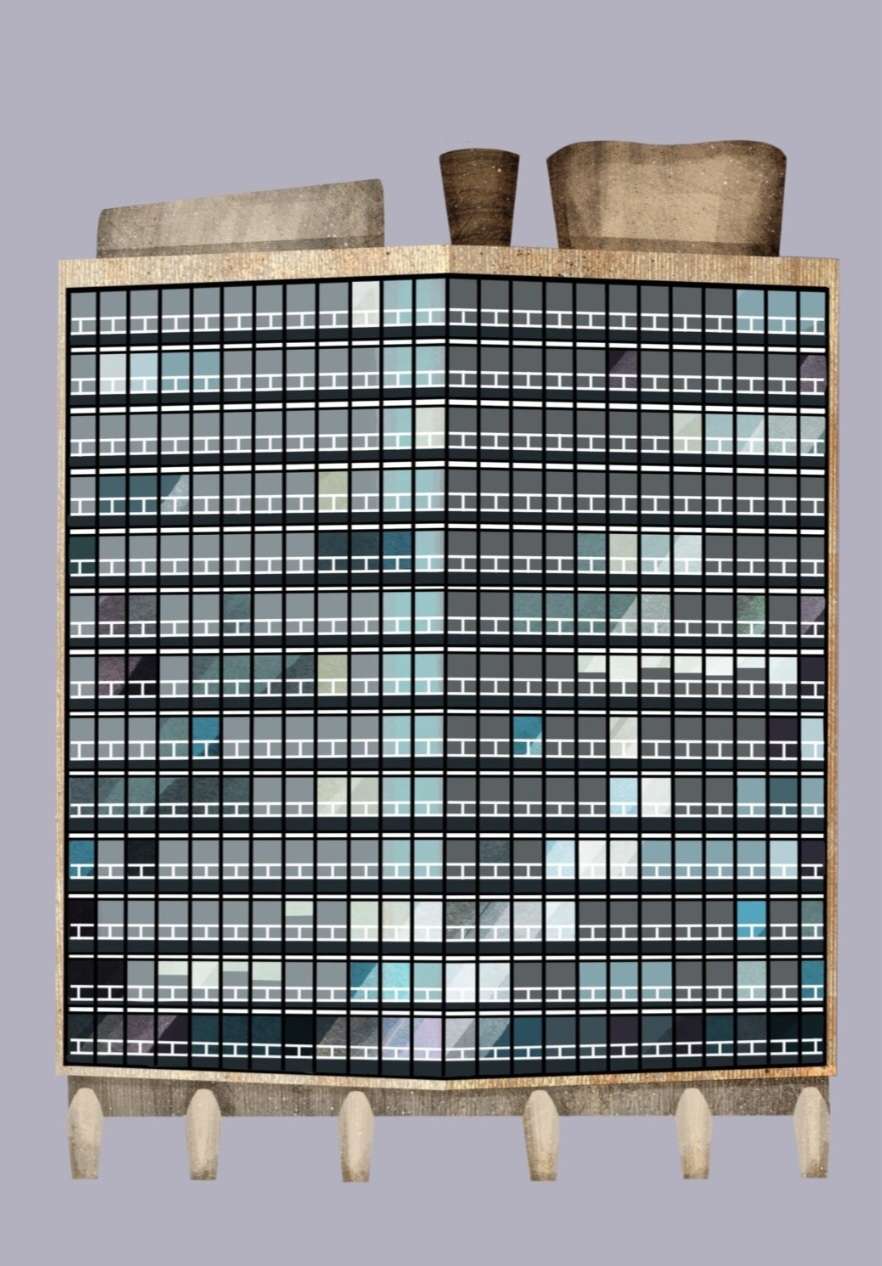
6. The Met Tower
The former College of Building and Printing building, better known today as the Met Tower, dominates this corner of the city centre.
Building: 60 North Hanover Street
Print: City of Glasgow College, 190 Cathedral Street, Glasgow G4 0RF
7. Our Lady and St Francis
The trail then heads east towards the Barras and Our Lady and St Francis, with its print hosted inside nearby Saint Luke’s.
Building: 72 Charlotte Street
Print: Saint Luke’s, 17 Bain Street, Glasgow G40 2JZ
8. The Gallowgate Towers
The final subject is another piece of Glasgow architecture that has vanished.
The Gallowgate Towers, also known as the Whitevale and Bluevale towers, have been demolished, but Nebo Peklo’s illustration keeps their distinctive appearance alive.
The print is displayed at Glasgow City Heritage Trust, which is also the recommended finishing point for anyone collecting all eight physical stamps.
Building: Demolished
Print:
When is the best day to do the trail?
If you want to collect all eight stops in one outing, we would suggest attempting the trail between Tuesday and Thursday.
That is because opening hours vary considerably. The Advanced Research Centre, Glasgow School of Art and City of Glasgow College are listed as weekday locations, while the Sauchiehall Street Cultural & Heritage District is open Tuesday to Thursday. Glasgow City Heritage Trust itself is open Tuesday to Friday.
Always double-check opening times before setting out, particularly if you’re travelling specifically to complete the trail.
Do you have to walk the whole trail?
Not unless you really want to.
The locations cover a substantial section of Glasgow, from Crow Road in Anniesland to the Gallowgate, so combining walking with Glasgow’s public transport will make completing it much easier.
Once you reach the city centre, several of the locations are reasonably close together, making the Savoy Centre, BOAC Building, Met Tower and Merchant City sections particularly suitable for exploring on foot.
Brutal Glasgow prizes
Complete all eight stops and you can enter a prize draw for Brutalist-themed prizes supplied by Spaceplay.
The organisers have also announced a special challenge for keen architecture hunters: the first person to visit all eight locations, collect their stamps and share their achievement on social media while tagging the organisers will win a special Brutalist-themed prize.
Don’t forget to share photos using #BrutalGlasgow.
What happens if you can’t access one of the prints?
Don’t panic if you arrive and find one of the locations closed.
Glasgow City Heritage Trust says visitors who have been unable to access a print can tell staff which locations they have visited.
They can provide the relevant app code or allow stamps to be collected at the Bell Street headquarters instead.
Why we think the Brutal Glasgow Trail is worth doing
You don’t necessarily need to love Brutalism to enjoy this. In fact, that’s rather the point.
Glasgow’s post-war buildings can provoke very different reactions. Some are regarded as architectural landmarks while others have spent decades being described as eyesores. Several have already disappeared.
The trail gives you an excuse to stop, actually look at these buildings and learn why they were built, rather than simply walking past them.
It’s also a slightly different way to explore Glasgow, taking you beyond the city’s usual Victorian architecture and into a fascinating period when architects were experimenting with concrete, towers and completely new ideas about how people should live and work.